Welcome to my blog

I hope you will find the recipe you are looking for your occasion here.

Now video instructions are available for select recipes and can be accessed at

Gardening and Cooking Made Easy

The latest 5 recipes are displayed on the
main page. For more recipes, you can browse the archive, click on the labels in the index to the left or use the Custom search below to look for a specific recipe.


Search for more results

Custom Search
Showing posts with label festive season. Show all posts

Sunday, October 27, 2013

Mango Barfi/ Mango Vadi

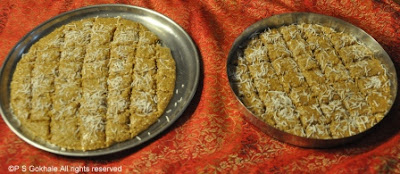
A very popular sweet in Maharashtra, it is a combination of two rich ingredients viz. mango pulp and mava. This was one of the first sweets that I had tried making at home once I figured out how to make mava. The result was so tasty, and my family loved it. The next year, I taught another friend how to make it and we made it together for her Diwali party. However, I didn't cook it to the right consistency and it turned out a little soft. It set into a semi-soft barfi in the fridge and I got several compliments on it. In fact, this softer version was compared to the one made by a famous Mithai house in Pune. Hence, this is a very forgiving recipe. Whether you cook it to the right consistency or make it a bit softer, the taste doesn't get affected, and is delicious.


Ingredients
2 cups mango pulp
1.5 cup mava/khoya/khava
2 cups sugar
1/2 cup powdered sugar (not icing sugar)


Method
Mix the sugar and mango pulp in a microwave safe bowl, and cook it in the microwave for 10 minutes, till the mixture thickens and changes color and darkens. Cook it in 2 minute increments and stir.
In a separate bowl, heat the mava in the microwave for 1 minute and then add this sugar and mango pulp mixture to the mava. Mix this well.

Grease a pan with some clarified butter and keep aside. 

Now, transfer this mixture to a thick bottomed pan and reduce the mixture till it starts to thicken. Make sure you are doing this on low-medium heat, so that the mixture doesn't burn. Keep stirring often. Let the  mixture thicken, till it is so thick, that when you stir it, you can see the bottom of the pan and the mixture doesn't flow back to cover the base of the pan easily. You can also try and take a small drop of the mixture onto a plate, let it cool slightly, and try to roll it into a ball. If you can roll it into a soft ball without it being very sticky, then the mixture is at the right thickness.


Take this mixture off the heat and let it cool down a bit till it is easy to touch without burning your fingers, but still warm. Then add the powdered sugar to it and mix well.

Pour this into the greased pan and using the base of a measuring cup or a steel cup, flatten it out into the pan. The thickness of this should be about 1/2 -3/4 inch. Let the mixture cool down a little more till luke warm and then cut it into squares about 1X1 inch in size.


As you can see from the pictures, I prefer making the softer version. It is great, irrespective of the consistency. 


Tips 
You can use any canned pulp. If you use fresh mango pulp, remember that it may be more watery than the canned one and you may need to use more pulp, else the taste of mango may not be very strong. Also, canned pulp already has some sugar added to it. If you use fresh pulp, you may need to increase the amount of sugar being used, based on how sweet the mango is.
If the mixture is too thick and you are unable to flatten it, add a little milk and cook it till it softens. If it is too soft, that you are unable to cut it without it sticking to the knife, then cook the mixture for a few more minutes. You can also let it set in the fridge over a couple of days. This easily lasts in the fridge for about 10 days to 2 weeks.
Don't use icing sugar, because it is a mixture of powdered sugar and cornstarch.

Thursday, November 8, 2012

Rava Laddoo/Ladoo - Sweet Semolina Balls

This is another Diwali favorite. This is another sweet snack like the besan laddoo and multrigrain laddoo, which can be made as a snack and stored for a few weeks. It is mainly made using semolina (farina) or rava and fresh grated coconut is also added to it. I have always heard everyone say it is one of the simplest laddoo recipes to make. I, however had made it only once so far. The main reason has been that I just couldn't remember how I had made it the last time (It was a recipe I asked from my Mom, of course). So this week I decided to make it again, much to the delight of my husband. I had asked my friends (some of them make this really well) for their recipe, however finding myself without one, I decided that the best course was to call my Mom and ask her to tell me the recipe again. Finally, I was able to make it. It turned out real great. And it is on the menu this year again for Diwali.


Ingredients
1 cup ghee
4 cups coarse rava/semolina/farina (if you just can't find the coarse one, you can use fine rava)
3 cups sugar
1 - 1.5 cup water
2 cups grated fresh coconute
1/4 tsp cardamom powder
1/4 cup raisins
1/4 cup blanched almond slices


Method
In a pan dry roast the coconut for 2-4 minutes till slightly dry. Keep aside. Heat ghee in a pan  to hold the rava and roast the rava till it is lightly browned and fragrant.  At the same time, in a pan that will be large enough to hold the rava and coconut, heat the sugar and water mixture to make a syrup. Once the syrup comes to a boil, take a drop on a plate and when it is warm to touch, pick this drop up between your forefinger and thumb and then separate out the finger slightly and see if you can see a strand of syrup between your fingers. If so, then your syrup is ready. This is called single strand/ single thread stage.
Take the syrup off the heat. Once it is slightly cooler (no longer boiling but still warm), add the cardamom, raisins and almonds and stir well. Then add the roasted rava and coconut and mix this mixture well. Let it cool till it is luke warm and can easily be held in your hand. At this temperature, take a fistful of this mixture and compress to make a round ball. Make all the balls and let them cool completely. Store in an airtight container. This will stay fresh without refrigeration for a couple of weeks. However, if you plan to store them for a longer time, put them in the fridge, so that the coconut doesn't become rancid.


Tips
The sugar syrup reaches the single thread/strand stage at approximately 220F/104C temperature. If you have a candy thermometer you can use that. However I find this method a more accurate indicator to check if the syrup is at the right consistency.

Remember to add the garnishes like raisins and cardamom to the syrup before adding the rava or coconut. This will ensure that the garish spread evenly through the mixture.
Now, if you do end up overcooking your syrup, the resultant mixture and laddoo will become very dry. If this happens, sprinkle about 1/4 to half cup milk on the mixture and warm it up and mix well. You can then re-roll it into laddoos.
If your mixture becomes too soft and the laddoos do not retain the round shape, then you can add 1/4 to 1/2 cup icing sugar to the mixture. Mix it thoroughly and then roll the laddoos.


 ter you

Tuesday, January 10, 2012

Til Gul Wadi/Vadi - Sesame Seed Fudge

The first week of January has passed by and we are inching towards 14th of January, when the first Indian festival of the year will be celebrated. This is "Sankrant" also known as Makar  Sankrant in India. It is a festival to celebrate the harvest season. This is one festival which almost always falls on the 14th of January (this year it was on the 15th) and is based on the movement of the Sun rather than the Moon. It is celebrated throughout India and is called by different names in different states. Some names that I am familiar with are Lohari (in Punjab), Uttarayan (in Gujarat), Makar Sankrant (in Maharashtra) and Pongal (in the southern states). In Gujarat, the entire day is spent on the terrace of the houses and in streets flying kites. It is one of the most colorful scenes I have ever seen. In Andhra Pradesh, it is celebrated over a period of three days.


In Maharashtra, it is celebrated by distributing sweets made from sesame seeds and jaggery. These are called "til gul vadi" and the tradition is to say "til gul ghya ani goad goad bola" which translates to "please take this sweet and speak sweetly". There are multiple variations in how this sweet is made, some are really hard in texture, some are brittle and some are soft. Each family has it's own recipe and tradition of making this sweet.

The ones I make have a soft texture and are easy to bite into and extremely simple to prepare. You can roll it into a ball and make a "laddoo" or you can flatten it and cut it into "vadi/barfi" akin fudge pieces. This is my Mom's recipe and my favorite version of this sweet. I hope you will give it a try and enjoy it.


Ingredients
1 cup sesame seeds
1 cup peanuts (shelled and without the peel)
1 cup finely cut jaggery, cup should be packed
1 tbsp ghee/clarified butter
2 tbsp of grated dessicated coconut, for garnish
some ghee to grease the plate in which the sweet will be set.


Method
Take a plate with an edge or a pan with a small edge and grease it with some ghee.
In a dry skillet, on low to medium heat, roast the sesame seeds till you get the aroma of the sesame seed.  Keep it aside and let it cool. In the same skillet roast the peanuts following the same method as for the sesame seeds. Be careful not to burn these ingredients. Once these cool down, coarsely grind them separately and then mix the two powders together.

In a pan, add the ghee and jaggery and keep it on a very low flame to cook. The jaggery will start melting. Be sure to keep it on very low heat.. Stir the jaggery so that it doesn't caramelize. Within a couple of minutes, the jaggery will start bubbling and foaming. At this stage, turn off the heat and add the powdered mixture of peanuts and sesame seeds and mix well together. Then pour this mixture (it will be quite thick) into the greased plate. Then using another bowl/measuring cup (grease the bottom), pat the this hot mixture and even it out into the plate. Make sure to level it properly. Then sprinkle the dessicated coconut all over the top and using the cup, pat it into the mixture. All this must be done while the mixture is hot.

Then, after the mixture cools a little, cut it into square pieces of about 1 inch sides. Let the mixture cool completely befor you take the individual pieces out of the plate.


Tips
You can roast the peanuts and the sesame seeds in the microwave. Initially you can do it for 1 minute intervals. Stir it after each minute and then you can reduce that to 30 second intervals. It takes about 2-3 minutes based on the power settings of your microwave. Let them cool completely and then grind.
If jaggery is kept on high heat, it will start caramelizing as soon as it melts, so be careful of the temperature. Also, it is necessary to turn off the heat as soon as the jaggery foams to get the soft consistency, the longer it is cooked, the harder the end product will be. If you feel that the jaggery syrup has become very thick, you can add some more ghee or alternately add a couple of tbsp of milk to the syrup to thin it out (if you add milk, this shortens the shelf life, so be sure to keep it refrigerated and eat it in a couple of days). If  after adding the sesame and peanut powder, the mixture becomes very dry and powdery, then sprinkle a teaspoon of warm milk and stir (while the mixture is hot). The mixture will immediately become moist (if it becomes too soft and moist, then re-heat it).  Then spoon the mixture into the greased plate.

If you forget to remove the pieces and then it gets difficult to take them out, heat the bottom of your plate or keep it in a warm oven for a couple of minutes and then it will be very easy to get the pieces out.

Sunday, October 16, 2011

Recipes for the festive season - Diwali Recipes

With Diwali right around the corner, I thought it would be a good idea to list out all the recipes that I have posted so far that you can make for the festive season. Many of these are ones that you make ahead and some of them can be made the day of. Here is a listing of sweet and savory recipes for the festive season. I also realized that I haven't posted a lot of savory recipes, so will be posting some through this week.

Sweets that can be made about a week in advance and which will stay for a couple of weeks.
Note: Make sure to keep anything made from milk in the fridge.
Gajar Halwa/ Carrot Pudding (keep refrigerated)
Modak-Sweet Baked Dumpling (do not refrigerate)
Dudhi/Doodhi Halwa- Squash Pudding (keep refrigerated)
Chirote/ Chiroti (do not refrigerate)
Shrikhand, Sweet Yogurt (keep refrigerated)
Nariyal Barfi - Coconut Burfi/Coconut Fudge (keep refrigerated)
Shakkar Pare/Shankar Pali/Sweet Fries (do not refrigerate)
Besan Laddoo/Laadoo - A Sweet made from Chickpea Flour (do not refrigerate)
Dharwadi Pedha/ Kandi Pedha - A Delicacy made from Milk (keep refrigerated)
Sweet Puffed Rice Balls - Kurmura/Murmura Ladoo (do not refrigerate)
Rasgulla/Rosogulla - A Cottage Cheese/Paneer Dessert (keep refrigerated)
Kaju Katli/Kaju Barfi/Cashew Mithai/Cashew Marzipan
Gujia/Karanji/Nevri/KarjiKayi - Indian Empanadas

Sweets that taste best when eaten fresh
Note: These will last a few days in the fridge
Modak, Sweet Steamed Dumpling (store in fridge)
Puran Poli (store in fridge)
Puran - Sweet Yellow Lentils (store in fridge)

Savory Recipes

Chiwda - Savory Dish made with Pressed Rice