Welcome to my blog

I hope you will find the recipe you are looking for your occasion here.

Now video instructions are available for select recipes and can be accessed at

Gardening and Cooking Made Easy

The latest 5 recipes are displayed on the
main page. For more recipes, you can browse the archive, click on the labels in the index to the left or use the Custom search below to look for a specific recipe.


Search for more results

Custom Search
Showing posts with label batata. Show all posts

Tuesday, June 13, 2017

Batata Vada/Batata Wada - Pressure Cooked Version

I have always embraced the concept of using a pressure cooker and trying to minimize effort without compromising on taste. In fact, I think I have used the pressure cooker almost daily for as long as I can remember since I learnt cooking. My very first lesson was how to cook lentils (dal) and rice at the same time in the cooker, layering the two on top of each other in different containers. Even now, every time I make these together, I recall my mom telling me to place the dal at the bottom since it takes longer to cook and the rice on top of the dal container, so that both can cook evenly in the same amount of time without overcooking either ingredient. I have posted several dishes on this blog that I have made in the pressure cooker over the years and shared my tips with you. And since I see pressure cooker popularity growing, I will try to keep posting more recipes. This is however a blog where I explore all kinds of cuisines made using all kinds of cooking methods and hope to keep updating it with recipes, which can be made for all different life occasions. I have been reading the book Pressure Perfect by Lorna Sass, who has been writing about pressure cooking since 1989 and is considered to be an authority on pressure cooking. She has explained the concepts of cooking at high pressure on high heat, layering based on the sugar content and cooking times of foods, using the right size heating element to heat the cooker, and other key concepts which help understand the science behind cooking under pressure. The book also contains good instructions on how to understand your cooker. She dedicates a few pages on observations to be made when you get a new cooker to then be able to use it to your advantages. This is to be done by heating water in it and determining when it comes to pressure as well as tracking how much water dissipates over time as it cooks. There are many other great write ups, books, forums and websites which extensively use pressure cooker based cooking and provide the scientific techniques to get the best use of your cooker and also explain the science behind cooking via layering, why certain foods may burn and how to handle them and other great insight. Here is a link to a fascinating history of the invention and development of pressure cooker based cooking, rooted in scientific work by French physicist Denis Papin in 1679. It shows the evolution of pressure cooking methods through the ages. And the evolution continues with the next generation of safe electric pressure cookers. So lets acknowledge the history and the scientists who have made this possible.http://discoverpressurecooking.com/history.html Since we are on the theme of batata vada with the garlic coconut chutney post earlier, I thought this would be a good post to follow, even though I have already posted the recipes for batata vada a long time ago on this blog.This post provides the traditional method of making authentic batata vadas, which works really well. The last time I ate batata vada, my friend had made a completely cooked stuffing, instead of keeping the onions raw as I had done with my original post. So, this time around I decided to try this version. I also made the pav/bread/dinner roll and the garlic chutney, which must accompany the vada pav to give it the authentic taste. I figured the way to make the batata vada stuffing easily would be to make the mashed potato stuffing with the seasonings at one go instead of boiling the potatoes separately and then adding them to the cooked and seasoned onions. As a side note, Lorna Sass makes mashed potatoes in her book in a similar way. Which just shows how wonderful the world of food is. By just changing the seasonings used in one food item, mashed potatoes in this case, it can be completely transformed into another.

So, I cut up raw potatoes into small pieces and using appropriate layering (keeping in mind the starches in potato), made the seasoned potato stuffing in the pressure cooker. I released the pressure and let it cool down a little and mashed it to make the stuffing. I had made the batter while the potatoes were being cooked and let the oil heat up in the time the stuffing cooled down.Well, after making this mashed potato stuffing, I used fistfuls and rolled them into small balls, dipped it in the batter and deep-fried them. I cooked the remaining stuffing and batter the next day, in the appe pan (aebelskiver pan), which turned out great as well. 


Ingredients
For the stuffing
1/2 onion, finely diced
2 large potatoes, diced into small pieces (about 1/2 inch by 1/4 inch) 
salt to taste
2 garlic pods, finely chopped or precooked garlic paste
1/2 inch ginger, finely chopped or precooked ginger paste
1 chilli, cut into pieces, or to taste 
1/4 cup cilantro, chopped
1/2 tsp sugar
1/2 lemon
2 tsp oil (or premade tadka/phodni/seasoning)
1/8 tsp mustard seeds
1/8 tsp cumin seeds
a pinch of asafoetida/hing
pinch of turmeric
3 tbsp plus 1 tsp of water

For the cover
1 cup besan/gram flour
1 tsp chilli powder
1 tsp oil, warm
1/4 tsp baking soda
salt to taste
1/8 tsp turmeric
water

Oil to deep fry the vadas - there should be about 2-3 inches of oil, so that the entire potato fritter can be fried easily. 

Equipment 
Pressure cooker (I have used a 3 liter cooker or the Instant Pot)


Method
In the pressure cooker or Instant Pot layer the ingredients as follows:

Layer 1 - Add 3 tbsp+ 1 tsp of water and oil. Add the mustard and cumin seeds to this layer. Add the chilli pieces to this.
Layer 2 - Add the ginger and garlic (if using fresh) to the oil+water layer. Then add a layer of onions. If using cooked ginger and garlic, add them on top of the onions. 
Layer 3 - Spread out the potatoes in a the next layer without disturbing the previous layer. 
Layer 4 - hing, turmeric, salt and sugar.

If using the premade tadka, do not add the mustard, cumin and hing to the layers as stated above. Just add the tadka to the last layer along with the turmeric, salt and sugar (as show in the picture).


Do not mix any layers. Close the lid and cook as follows:

Pressure cooker - Cook this at high heat for 3 whistles.  I have an electric glasstop stove and I use the 8 setting. Let the cooker cool down and the pressure fall.  
Instant Pot - 4 minutes on manual mode. Let the pressure fall. 

Then open up the lid and mash the potatoes and mix well. Add the lemon juice and cilantro and mix well. Your stuffing is ready.


Take a fist full of this stuffing and roll out the potato mixture into small balls, about 1.5 - 2 inches in diameter. Keep aside.

In a mixing bowl, mix together the besan, chilli powder, salt and baking soda. Add some oil which has been warmed and then add some water. Add a little water at a time and mix to form a batter. The consistency of the batter should be thick so that when you dunk the potato balls the batter should coat it evenly. 

Deep Frying
Heat the oil. Then, dunk a potato ball into the batter and gently drop it into the oil. (be very careful not to splash any oil on you). Add about 3-4 vadas only at a time. Do not over crowd your frying pan. Fry the vadas till the cover is evenly brown. 

Shallow Frying in Appe/Aebelskiver Pan
Add a little oil to each of the appe pan disks. Then using the same process, dunk the potato ball into the batter and place it into each disk. After it is cooked on one side, turn it over and cook the vadas turning them over till the cover is well cooked on all side.

Serve with garlic coconut chutneyor spicy mint chutney


Tips
If the potatoes are directly touching the base of the cooker, there is a greater chance of burning. The water, oil provide a buffer to the onion layer and these three together protect the potatoes from burning. You can add a little more water to prevent the potato from burning.  Make sure to drain any extra water once you open the lid and then adjust seasonings that may get drained with the water and taste the stuffing before frying. If you forget to drain the water and it becomes too soft, then just cook the mixture for a couple of minutes to dry out the water. To make the tadka, heat oil and add the mustard and cumin seeds. Once they crackle, add the hing and turn off the heat. You can add the turmeric to the hot oil itself instead of the potatoes.
-->

Saturday, June 10, 2017

Garlic Coconut Chutney

This is a chutney that is an absolute must with Batata Vada or Vada Pav to get the authentic taste of the dish.  It is a perfect side to any Indian meal and has a slight pungent taste from the garlic. This is made mainly with two ingredients, viz. garlic and coconut but with a couple of added spices, this packs a ton of flavor.

Whenever I eat batata vada with this chutney, it takes me to childhood memories. We used to take trips during summer vacations, and many of those used to be between Pune and Mumbai. We used to take the train and the highlight of the train journey for me was the delicacies we would be able to eat on the way. My parents did not encourage eating street food and used to prefer home made food. Since, this was  one of the rare times we got to eat these foods, I used to look forward to it eagerly. The train used to stop at Karjat station for just a few minutes. This was famous for the batata vadas that one could buy at the station and the taste was just amazing. During that brief halt, my dad used to get off the train and buy vada pav, which used to be served with a generous amount of this chutney mixed with bits of the fried vada batter. These few moments filled with excitement and thrill as the train stop was literally just a few minutes and many a times it used to start moving without my dad in sight. Every time my heart would be pounding with worry that he had been left behind. And I still remember the sense of relief when I used to see him walking with the packed of the vadas in his hand. At that age, I didn't like the vada pav combination and used to enjoy the vadas with this chutney.

It has been decades since I made that journey, but that taste lingers on and whenever I make batata vadas, whether there is pav or not, this chutney always accompanies it, helping me rejoice in my nostalgia.


Ingredients
1/4 cup garlic cloves
3/4-1 cup dessicated coconut, shredded/grated
salt to taste
red chilli powder to taste, I added 1/2 tsp
1/2 tsp sugar


Method
Cut the garlic cloves into smaller pieces for ease of grinding. Then put all the ingredients in the blender and using the pulse function, grind this to make a finer consistency. Do not add water and do not make a paste. Open the mixer every few pulses and scrape it down and mix up the chutney. The coconut threads should still show a little and the garlic gets a pasty texture. You can over blend in the mixer, but it will still taste great.

The best texture or consistency is obtained by mixing it using a mortar and pestle, which is how I made it this time. I make it both ways depending on how much time I have.

Store this in an airtight container, in the fridge and it will last you over a month.


Tips
The garlic has a pungent smell, so be careful of how much chilli powder you add. You can always add more and mix it into the chutney after it has been ground. The scraping and mixing of the chutney while in the mixer, will prevent the coconut from getting pasty and releasing oil.

Saturday, December 17, 2011

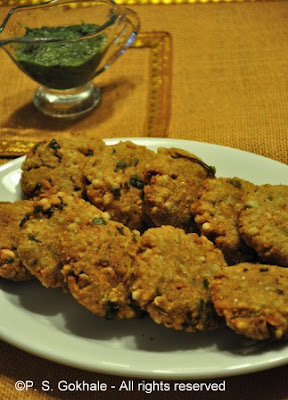
Sabudana Vada/Wada - Tapioca and Potato Fritters

This is an absolutely delicious delicacy. Tapioca is called "sabudana" in the Hindi and Marathi languages (the pronounciation varies a little), and Vada/Wada refers to deep fried dumplings. "Sabunada Vada are deep fried fritters/dumplings made with tapioca and potato, with a lot of ground peanuts sprinkled in. Absolutely lip smacking!! This is a dish that is reserved for special occasions and is one of the foods approved to be eaten on fasting days. However, most folks make it because it is so tasty. Over the years I have eaten this often, in different restaurants, at home and cooked by others and I must say, sometimes the vada can taste terrible, very chewy and dry. As a result, I had always been hesitant to make it, thinking that the recipe to get it perfect could be quite complicated. Finally, upon my family's repeated requests, I decided to try it out. I followed the advise of mom and lo and behold the end result was delicious. I am always thrilled when I am able make a recipe that I have always thought to be difficult. This one has a great end result,  and I hope you enjoy this recipe as well.


Ingredients
2 cups tapioca/sabudana (it should measure 2 cups after being soaked. Start off with 1 cup dry tapioca)
2 large potatoes, boiled and mashed
1 cup shingada/singada/singoda flour (water chestnut flour)
1 cup ground nut powder (see tips for how to make this)
1 tsp cumin powder
green chillies, finely chopped (5-8, to taste)
1/4 tsp baking soda
salt to taste
1/2 cup cilantro, chopped
1 tsp lemon juice
1/2 tsp sugar
1 tsp oil, luke warm
oil to fry


Method
See tips on how to soak the tapioca. Take the soaked tapioca and then crush it lightly, by processing in a blender or food processor. This will make it easier to mix it in with the potatoes. Then mix together the processed tapioca, singoda flour and potates. Add salt, cumin powder, ground nut powder, baking soda, and the cilantro. Add the lemon juice, sugar and the luke warm oil. Now mix this all together and knead a little, to form a dough. Take a fistfull of this dough and form it into a ball. Then flatten it to make a disc. Rest these discs on a plastic paper/sheet, so that it doesn't stick to the plate. The discs should be about 2-3 inches in diameter.


Heat the oil in a deep pan. There should be at least 3 inches of oil so that the vada can be entirely immersed in it. To test if the oil has heated enough, drop a inch of dough into the oil. If it rises up slowly, the oil is hot enough. The vadas need to be fried medium heat, so that they cook through. If fried on high heat, they will get cooked on the outside but will stay raw in the center.  Now, slowly release one vada from the side of the pan, it will go to the base of the pan and then slowly rise, once the vada starts gettting cooked. The vada will puff up and once browned, is ready to be taken out. Let the vadas rest on a paper towel to absorb the oil. These vadas will be light and very crispy. Serve with green chutney.


Tips
Singoda/shingada is water chestnut. You can find singoda/shingada flour in the local Indian store. Fry only 1-2 vadas at a time. As soon as the vada is added to the oil, the temperature of the oil decreases. So, fry only a couple at a time so that they get fried evenly and cooked through completely.
I also baked this dough, at 405 F for about 10-15 minutes, turning it over once, but these were not as crispy, though definitely low in calories.
To soak the tapioca, cover it completely with water such that there is enough water to cover all of hte tapioca and then add some more so that the water level is about a centimeter above the level of the tapioca. Soak this for at least 3-4 hours or overnight and then drain the water.

Wednesday, October 5, 2011

Batata Vada/Wada (Fried Potato Fritter)

"Batata vadas" are fried spicy potato fritters. It is one of the most common street foods in Maharashtra. Sandwhich one in a bun, add chutneys and voila, it is now a very Indian "burger". I have so many fond memories related to batata vadas. One that stands out is one rainy afternoon when my Dad and I had gone on a short hike on the outskirts of the city. There was a bracing wind, and a slight drizzle which soon turned into a downpour. Fortunately, we took found a small restaurant and took refuge there. Then, my dad ordered a plate of batata vadas with some hot tea. It was just fabulous! While the restaurant was pretty run down, the vadas were hot and tasty and the hot tea,the perfect drink for two drenched souls. Now, whenever it rains, I always wish that someone would hand me some vadas and tea. Well, I finally fried some when it rained the last time and they were lip smacking. So, next time it is dull, grey and pouring cats and dogs, whip up a batch and enjoy.


Ingredients
For the stuffing
1/2 onion, finely diced
2 large potatoes, boiled and mashed
salt to taste
2 garlic pods
1/2 inch ginger
2 chillies
1/4 cup cilantro, chopped
1/2 tsp sugar
1/2 lemon
2 tsp oil
1/8 tsp mustard seeds
1/8 tsp cumin seeds
a pinch of asafoetida/hing
pinch of turmeric

For the cover
1 cup besan/gram flour
1 tsp chilli powder
1 tsp oil, warm
1/4 tsp baking soda
salt to taste
1/8 tsp turmeric
water

oil to fry the vadas - there should be about 2-3 inches of oil, so that the entire potato fritter can be fried easily.


Method
Grind the green chillies, ginger and garlic into a paste. Mix it into the mashed potatoes. Mix in the onions and cilantro. Then add the sugar and salt to the mixture. In a small pan, hehe at the oil and add mustard and cumins seeds. Once they crackle, add the hing and turmeric. Turn off the heat and pour this onto the mixture. Mix well. Then squeeze some lemon juice into this mixture.

Roll out the potato mixture into small balls, about 1.5 - 2 inches in diameter. Keep aside.


In a mixing bowl, mix together the besan, chilli powder, salt and baking soda. Add some oil which has been warmed and then add some water. Add a little water at a time and mix to form a batter. The consistency of the batter should be thick so that when you dunk the potato balls the batter should coat it evenly.


Heat the oil. Then, dunk a potato ball into the batter and gently drop it into the oil. (be very careful not to splash any oil on you). Add about 3-4 vadas only at a time. Do not over crowd your frying pan. Fry the vadas till the cover is brown. Serve with spicy mint chutney and tamarind chutney.


Tips
If you add more water to the cover batter by mistake, add a little more flour and adjust the salt and chilli levels to taste. To check if the oil is hot enough, drop a little batter into the oil and if the droplets come up immediately, then the oil is hot and ready to fry the vadas.

Wednesday, March 16, 2011

Masala Dosa - Crepes with Potato Filling

As a kid I used to love plain dosa also known as "sadha" dosa. In fact the only thing I ate when we dined out . It was later, during middle school years that I started liking masala dosa. What makes a dosa "masala" dosa, is the addition of potato curry to the dosa. The combination is absolutely delicious and a complete meal. So, if you want to introduce someone to masala dosa, try this great recipe.  Enjoy!

The method to make the dosa and the perfect dosa batter is here.


Ingredients
For the dosa batter
See perfect dosa batter recipe

For the potato curry
3-4 medium potatoes, boiled, peeled and chopped into cubes
salt to taste
2 tbsp oil
1/8 tsp mustard/rai seeds
1/8 tsp cumin seeds
1 tsp urad dal
pinch of asafoetida
5-6 curry leaves (optional)
1/8 tsp turmeric powder
salt to taste
cilantro to garnish, chopped


Method
To make the potato curry filling
Heat the oil in a pan. Add the mustard and cumin seeds. Once they start to crackle, add the asafoetida, curry leaves, and urad dal. Let it cook till the urad dal is lightly brown. Add the add the potatoes, then the turmeric. Stir so that the turmeric is well mixed in and the potatoes are coated. Cook this for a a few minutes. Garnish with chopped cilantro.
 
To make the dosa
See perfect dosa batter recipe
Once the dosa has been cooked on both sides, flip it back so the side that was cooked first and is browned is down on the pan and the side cooked later is on top. Then add 1/4th cup of potato curry on the center of the dosa. Then fold one side of the dosa and then the other like closing a flap. The masala dosa is ready. Serve hot with chutney and sambar.


Tips
Don't over cook the potato when boiling it, else the potato curry will become mushy.

Monday, October 4, 2010

Batatyachi Bhaaji - Curried Potatoes with Ginger

This is possibly one of the simplest but tastiest potato preparations. It demonstrates the basic principles of cooking any vegetable in an Indian style. A basic "seasoning" or "tadka", followed by the addition of vegetables. And then you can choose to add any spices if you want. This was the very first recipe I made when I learnt how to cook. I remember standing at my mom's elbow and walking through the steps with her. It seemed like a lot to remember at that age (I was about 10 years old) but once you know how to create the initial seasoning, you have learnt the basic principle for Indian cooking and can cook practically any dish.


This potato curry is a very popular dish and is generally made for traditional Maharashtrian lunches or dinners. Since garlic and onions are not used in the dish, this is a popular choice during traditional and religious events. I really love the taste of this dish and make it whenever I want to eat food that takes me back home.
 

Ingredients
3-4 medium potatoes, boiled, peeled and chopped into cubes
1 tsp ginger and green chilli paste
salt to taste
2 tbsp oil
1/2 tsp mustard/rai seeds
1/2 tsp cumin seeds
pinch of asafoetida
5-6 curry leaves (optional)
1/8 tsp turmeric powder
salt to taste
1/2 tsp sugar
cilantro to garnish, chopped


Method
Coat the boiled, cubed potatoes with the chilli and ginger paste mixture, add some salt and the sugar. Mix well and set aside. Heat the oil in a pan. Add the mustard and cumin seeds. Once they start to crackle, add the asafoetida, curry leaves, turmeric. Stir and add the potatoes. Cook this for a a few minutes. Turn off the heat. Garnish with chopped cilantro. Serve with hot chapatis.


Tips
If you pressure cook the potatoes, be careful to take it off the heat after the time required to cook them in your pressure cooker, do not over cook them, else you will end up with mushy potatoes. To make ginger and chilli paste, grind 1 inch of ginger with 2-3 green chillies and a couple of pinches of salt. You can reduce the number of chillies depending on spicy you want your curry to be. Boiled potatoes should not be rinsed with cold water to cool them down. Just drain the water, and keep them aside to cool down before cutting. If they are rinsed in cold water, it may make them mushy, specially if they have been slightly overcooked.