Welcome to my blog

I hope you will find the recipe you are looking for your occasion here.

Now video instructions are available for select recipes and can be accessed at

Gardening and Cooking Made Easy

The latest 5 recipes are displayed on the
main page. For more recipes, you can browse the archive, click on the labels in the index to the left or use the Custom search below to look for a specific recipe.


Search for more results

Custom Search
Showing posts with label culinary tour. Show all posts

Saturday, January 15, 2022

Culinary Tour of the World: Episode 8: Armenia - Lahmajoun and Tan

Welcome to our eighth episode of the Culinary Tour of the World. This post takes us to Europe, to the country of Armenia.  It took me a while to decide on what I would cook from Armenia. I had originally settled on lavash as it is a bread that I really like and definitely want to start making at home. However, as I started researching and exploring the foods, I found this Armenian "pie" or "pizza" which is really popular called Lahmajoun.  Traditionally it is a meat pie/pizza which has a very thin crust and a paste like meat filling which is spread across the crust. To convert it to a vegan version, I substituted chickpeas for the meat. You can also use kidney beans or soy granules. During my research across blogs and Youtube, I found versions where the crust was described as crispy and also where the crust was soft such that this could be folded or rolled. Also, I noted that for a quick version, store bought tortillas can be used. So, I tried out all the variations and my conclusion is that the version with the home made dough tasted the best. From a texture perspective, the softer version which could be rolled up was one that I liked because the topping was soft and moist whereas my husband enjoyed the crisper version which where the dough was stretched out really thin. 

In one of the recipe videos, I stumbled across this yogurt drink called "Tan" which is very similar to the Indian lassi. It was the perfect accompaniment to the Lahmajoun. The two together made a delicious and complete meal!


I really enjoyed making this because I also learnt how to make "red pepper paste" which is a key ingredient for the Lahmajoun and used in Armenian cooking and recipes in this region. In addition this was a great recipe because I learnt how to make another kind of a dough which can be rolled out really thin and can be used to make a quick thin crust pizza. I am sure that I will be making this dish often, especially the dough to make other pizzas/pies with different toppings. 

Note: This recipe makes a large amount of filling/topping. To use the entire filling, double the dough ingredients.  Alternately halve the ingredients for the filling. I added boiled potatoes and bread crumbs to the leftover filling and made delicious patties the next day. 

Here is the video of how to make Lahmajoun and Tan.

Ingredients

For the red pepper paste
2 red bell peppers, coarsely ground into small pieces in a food processor or blender
1/4 tsp cayenne pepper
1/2 tsp salt

For the dough
3 cups of all purpose flour
1/4 tsp yeast (optional)
1/2 tsp sugar
1/2 tsp salt
1.5 cups water
olive oil to grease the bowl
extra flour to flour work surface

For the filling/topping
1.5 yellow onion, finely diced
3 tomatoes, deseeded and finely diced
1 red bell pepper, finely diced
6 garlic cloves, finely minced
1 bunch of flat leaf parsley, finely minced
3 cans of chickpeas, drained and rinsed (15 oz/439 gm each)
2 tbsp red pepper paste (if you are making the paste as I did, use all the paste)
2 tbsp tomato paste
1 tsp of black pepper powder (I used 1 tbsp and it was very spicy for me, so start with 1 tsp and adjust as needed)
1 tsp chilli powder
1 tsp paprika
1/2 tsp cayenne pepper
salt to taste
olive oil

For the tan (yogurt drink)
1 cup yogurt
1/2 cup water
salt to taste
mint, to garnish


Method
For the red pepper paste
Finely mince the bell pepper or grind it coarsely. Boil it in a pan with cayenne pepper and salt. Cook it till the water evaporates and the texture becomes paste like. 

For the dough
If you want to make the pies immediately add the yeast, else if you have a couple of hours for the dough to rest, then you don't need the yeast. The dough should not rise and it should be soft and supple so that it can be rolled or stretched really thin.  I was going to cook it immediately, so I used the yeast. 
Add the flour, dough, salt and sugar to a bowl and mix well. Then add the water a little at a time. I did end up using all of the 1.5 cups of water and kneaded the dough in the stand mixer for 5 mins. The resultant dough was very sticky and soft. Remove it from the mixer onto a floured surface and knead by hand for a couple of minutes.  Grease the bowl with some oil and place the dough back in. It will still be very sticky. Once I let it rest for 10-15 mins it became soft and supple.  
It is easier to make this in a stand mixer, but if you are making it with hand, I would recommend skipping the yeast and allowing enough time for the dough to rest so that you don't have to knead a very sticky dough. To make this by hand, use a wooden spoon to mix all the ingredients so that the flour is completely incorporated into the dough. Then cover and let it rest for at least an hour and the gluten will build up and one you knead the rested dough, it will become supple. Then rest the dough again to let the gluten strands relax so that you can roll it out easily.

For the filling/topping
I used the food processor to finely mince all the vegetables, the onions, tomatoes, garlic, bell pepper and parsley. Then drain the chickpeas, rinse them well, drain well and then grind coarsely in the food processor. The filling texture is like a thick coarse paste. It holds together but  it is not smooth like hummus. 
The vegetables do release a lot of water when cut with a food processor, so I made sure to drain the chickpeas really well before grinding them coarsely in the food processor. So the resultant mixture was not watery.  
Add the red pepper paste, tomato paste, black pepper powder. chilli powder, paprika, cayenne pepper and salt. Mix all the ingredients well. The topping is ready.

Assembly and cooking
Preheat the oven to 500F and place the rack in the lower third of the oven. 

Liberally flour the rolling surface. Then take a fistful of dough and shape it into a ball. Roll out the dough, dusting the dough and surface with flour as you roll it. It should be a thin disc such that it is almost translucent. Then place it on a baking sheet.  Spread a thin layer of the topping onto the dough. Place this in the hot oven for about 10-15 minutes till the bottom of the dough is  golden brown. You can also cook it on a hot skillet on the stovetop, covering it while cooking. 


You can serve it as is or add some vegetables on the top and fold it over or roll it into a wrap. 

To make the Tan
Blend the yogurt, water and salt. Pour it into a glass and add some mint as a garnish.  

Tips
The tomato and red bell pepper pastes have a concentrated flavor and hence add to the flavor of the filling. However if you don't have it, I think you can get away with not using it. Make sure to let the dough rest between kneading and rolling out. It will be easier to roll. The oven or skillet should be really hot. 


Saturday, August 21, 2021

Culinary Tour of the World: Episode 7: Argentina - Tarta De Acelga Cremosa

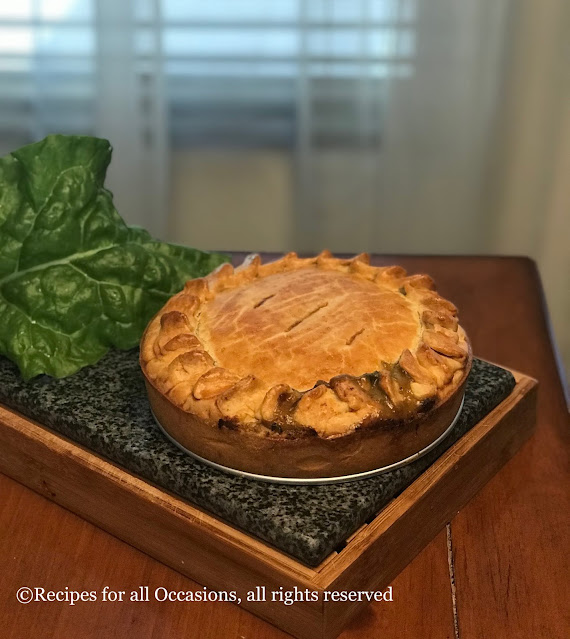
Welcome to our seventh episode of the Culinary Tour of the World. This post takes us to the South American continent and we are making a delicious dish from Argentina. Argentina is known for its meat dishes, however as I started researching the foods, I realized that there were several vegetarian options to choose from too. So, I turned to my garden for inspiration. It was late spring when I made this and we had an abundance of eggplants and chard. So, I decided to focus my search on dishes which could be made with these two vegetables. I came across a simple recipe of grilled eggplant sliced, which were cooked with some salt, oil and cumin. I cooked up a large batch of eggplants in this manner and we ate them as is and it was delicious. I also used them in tacos and also froze a couple of batches. This seemed too simple for the video series though, so I decided to make another dish. I finally decided to make a chard pie called Tarta De Acelga Cremosa. This hearty, delicious pie is filled with a creamy chard filling and boiled eggs. The pie is a complete meal given that it has a hearty crust, eggs and a delicious sauce and green vegetables too! I skipped the boiled eggs and it still made a hearty meal.


This was a recipe, where I did not find a video, and so all I had were instructions from a reading a few Spanish language blogs. I read them all using google translate and I did have a couple of missteps with the recipe, which you can see in the video. One was that I added to much milk when I made the sauce, because of which I had to cook the filling for a much longer time. Another was cutting the pie when it was piping hot. This made the filling spill out.  So the instructions I am providing below include these adjustments  and additional notes to ensure that the end result will be great. With that said, here is the recipe.

Link to the video recipe


Ingredients

For the pastry dough
300 gm all purpose flour
1/2 tsp salt
1/2 cup or 1 stick unsalted butter
1/3 - 2/3 cup water,  ice cold
1 egg + 1 tsp of water for the egg wash 

For the filling
4 tsp oil 
15 chard leaves and stems, diced
1 large onion, diced
4 cloves of garlic, minced
black pepper powder, to taste
1 tsp ground mustard, adjust to taste
1 tbsp cream cheese
1/4 cup mixed soft cheeses (cheddar, monterey jack). I have used Mexican cheese blend
1/4 cup parmesan cheese, grated
pinch of nutmeg powder
salt to taste
 

Method

If you have a food processor, use it to make the dough. Add flour, salt and cold butter pieces to the food processor and pulse till the butter is cut into the flour and it gets a sandlike texture. Then add a little water at a time and pulse till the dough comes together into a soft dough. Do not over mix the dough. 
If you don't have a food processor, rub the cold butter into the flour till you get a sand like texture and then add the water to make a soft dough. 

Divide the dough into two and then flatten it into discs. Cover with plastic wrap and refrigerate.

Heat oil and add onions and garlic. After you fry them for a few mins and the onion softens, add the chard stems. Saute it for a few mins till the stems start to soften. Then, add a tablespoon of all purpose flour. Mix it in and let it cook for couple of minutes but don't let it brown. Cook the flour and mix it in well, so that when the milk is added, there are minimal lumps. Next, add the milk and stir while you add the milk, making sure there are no lumps. Then add the chard leaves.  Now, this is where I was tempted to add more milk to the sauce to increase the quantity of the sauce, because I felt that there was a lot of chard. However, remember that the chard leaves are going to wilt and add moisture to the sauce and they will shrink. So, resist the temptation and let the leaves cook, till they are nicely mixed into the sauce and have been cooked. Now, add the cheeses and stir them in till they melt. Finally, taste this and then add salt, if needed. Chard has a salty flavor profile and the cheeses also have salt, so you want to be careful and add salt only after tasting it. Let the mixture cool completely.

Preheat the oven to 450F or 200 C. Now roll out one disc of dough into a round pastry which is about 1/8th inch in thickness and about 11-12 inches in diameter. Place this into a deep baking tin. If the tin has a removable bottom, it will be easier to remove the pastry, but that is not necessary. Press the pastry to align to the edges of the tin. Then pour the cooled filling into the pastry. 

Roll out the second disc of dough in the same manner as the first and then place it on top of the filling. Adjust the dough to cover the filling completed. Press the edges of the bottom and the top dough sheets by pinching them and then crimp it to decorate it. Crimping will also ensure that the pie will not leak due to the pie crust splitting where the two sheets meet. Make a couple of slits in the pie top to allow for the steam to escape. 

Then place the baking tin onto a baking sheet and place it in the hot oven on the middle rack. Bake for an hour till the pastry has a golden brown color. Remove the tin and place it on a rack to cool for 10 mins. Remove it from the baking tin if it is easy to remove and let it cool down on the rack. Else you can cool it down completely in the pan and serve it straight from the pan. 

Cut into slices and serve. 


Tips
Do not make the filling too watery. As I detailed in the method, it is important to not add extra milk than what the recipe calls for.  Make sure that the filling is completely cool before filling into the pastry shell. Make sure you cool the pie before cutting otherwise the filling will flow out. 


Thursday, September 24, 2020

Culinary Tour of the World: Episode 4: Andorra - Torrijas

 Welcome to our fourth episode of the Culinary Tour of the World. This post takes us to Andorra. Andorra is a very small country, described as a tiny independent principality, in Europe. It is between France and Spain in the Pyrenees mountains. I had not heard about it till I started this project. So far, this has proven to be the a difficult one to choose a recipe from, because there are just a handful of recipes that are called out as traditional Andorran foods. Of those, the majority of them are meat dishes and include delicacies like snails. Also, I really wasn't able to find a blog which was written by a person from Andorra. As I researched vegetarian recipes, I kept coming across just 2-3 recipes which were common across travel sites, blogs and even books. One of them was Pa amb Tomaquet, which is bread rubbed with garlic and tomatoes, and another was spinach with pine nuts and raisins. There was a third once called Trinxat which is potato and cabbage cake or like hash  browns which is topped with bacon. I thought I could make all these (skipping the bacon) and make a small meal. However, they were all sides and given how meat heavy the entrees were, taking the meat away would not give the same experience.


So, I asked a friend who lives in France who suggested that I look for Catalan recipes. That was a great suggestion and that took me to menu cards of Andorran restaurants. Since I couldn't find a vegetarian entree, I started looking for desserts and breads. I found a mention of a bread called Coca de Massegada which was listed as a very traditional bread but I was unable to find an authentic recipe for it. I found a list of ingredient, but there were no measurements and I did not want to experiment a lot. Finally, I settled on two choices Bunyols de vent which sounded like doughnuts made from a pate choux dough and Torrijas which is a dessert French toast which has a Catalan/Spanish influence. 

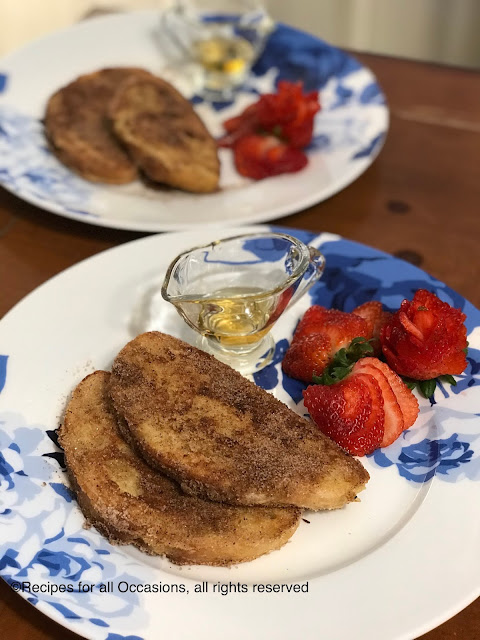
The plan was to make the Bunyols de vent, but I was inspired to make Torrijas for breakfast and the family absolutely loved it. So this is a delicious french toast, where the difference is that the bread is not soaked in an eggy batter like the traditional French toast. Instead the bread is soaked in milk and then dipped in whisked egg and pan fried. Then it is coated with cinnamon sugar and served with syrup. The milk can be boiled with fragrant spices to add more flavor. The end result is similar to churros. The outside gets crispy and the inside is soft and delicious. While this is meant to be a dessert, it is delicious as a brunch too and we have enjoyed this so much, that it has been added to the weekend brunch repertoire. This is a very simple and delicious recipe. Do give it a try!

Here is the video link to the Torrijas recipe


Ingredients
6 slices of Italian bread, stale (any type of bread which is cut into thicker slices than sandwich bread. Can also use sandwich bread bread but make sure it is a little stale and dry)
1 cup milk
4 tbsp sugar (adjust to taste)
1.5 tsp cinnamon powder
2 tbsp oil
2 eggs
1 tsp vanilla essence


Method
Mix the cinnamon and sugar together to create the cinnamon sugar. 

Whisk the eggs and vanilla essence together. Warm up the milk till it is lukewarm. If you want to add more fragrant spices to the milk, boil them with the milk and then let the milk cool for a few mins till lukewarm. Add 2 tbsp of sugar to the milk. Pour the milk into a tray and lay the bread slices in the milk. Let it stay till the milk is absorbed, up to 30 mins. Heat a tbsp of oil in a pan and then dip the bread slices in the whisked egg and then place it in the pan. Fry the bread on both sides till golden brown at medium heat. Then place it in the cinnamon sugar and coat it on both sides with the cinnamon sugar. Add more oil and fry the rest of the breads. 

Serve with syrup. It was delicious warm as well as cold. As a dessert, it is eaten cold per what I have been able to determine. 


Tips
I add vanilla essence to the eggs so that there is no eggy smell. You can skip this or add the essence to the warm milk. Fragrant spices which can be added to the milk are cloves, cinnamon, cardamom, vanilla, and lemon rind/zest.


Friday, August 28, 2020

Culinary Tour of the World: Episode 3: Algeria - Mhadjeb or Mahdjouba

Welcome to our third episode of the Culinary Tour of the World. This time we are headed to Algeria. Algeria is in Northern Africa. As I started researching Algerian food, I read that the cuisine is influenced by all the exchanges with different cultures and people over centuries.  There is a heavy French influence (it was a French colony) and a common breakfast I observed was croissant and coffee.  I saw a lot of delicious recipes including pastries. I have noted down quite a few recipes I would eventually like to try out.  As I started reading more about the food and googling the traditional names, I came across several blogs and video which were mostly in French and some in what I think was Arabic. It was difficult to choose a recipe because there were so many choices! 

Couscous and a stew  would have been perfect but I thought I could make that any day and wanted to choose something new which I had not heard of.  I almost chose a pizza recipe which is said to be over a 100 years old. I finally decided to go with a street food called Mhadjeb (singluar) or Mahdjouba (plural). In my experience, street food is usually something everyone enjoys and is very special to a place, so I thought it would be a good choice. 

Mhadjeb can be best described as a flavorful savory pastry of layered semolina dough, with each layer as thin as a phyllo sheet, which is filled with a sweet and tart filling of caramelized onions and tomatoes.  The recipe made me curious. I wondered how a simple filling of just onions and tomatoes would taste. Based on the description of the pastry cover, I deduced that it would be crispy and the covering would be delicious for sure.


I had some challenges with this recipe, as the recipes I found which seemed authentic were in French and Arabic. I was able to finally leverage the French I had studied in high school and with the help of google translate make enough sense of the recipes.  The final result was delicious! I read that if this pastry is made without filling it is called Msemmen and is a delicious accompaniment with tea or coffee. So, one recipe with two uses. I am definitely going to make it again. 


Our next country will be Andorra. This has been a particularly difficult one to find vegetarian recipes for, so if you have suggestions, please add that in the comments below. 
You can find the link to all our previous episodes here and the Culinary Tour playlist will take you to all the videos. 

Here is the video link to the Mhadjeb/Mahdjoba recipe. 


Ingredients
For the cover
1.5 cups fine semolina or semolina flour
1/2 cup all purpose flour
1 tsp salt
1/2- 3/4 cup water (enough to knead a very soft dough)
oil

For the filling
2.5 tbsp oil
2 large or 1/2 kilo onions, finely sliced
2 large or 1/2 kilo tomatoes, pulp (see method)
1 tsp of garlic, finely minced
salt to taste
pepper to taste


Method

For the cover

Mix together the semolina, all purpose flour and salt and then add the water to make a soft dough. This dough needs to be kneaded really well. So if you have a stand mixer or food processor, knead it in the machine for about 15 mins. Else, if kneading by hand, after mixing it set it aside to autolyse for 15-20 mins and then knead by hand for 15 mins like you will knead bread. The resultant dough will be soft and sticky.  Spread a little oil in a plate to coat the surface. Then divide the dough into 6-7 pieces and then roll each one into a smooth ball of dough. Place this on the oiled surface. Cover the plate with plastic wrap and let the dough rest for a minimum of 30 mins to about a couple of hours. The dough (and gluten) should be really relaxed to be able to pat the dough out into a very thin sheet. 

For the filling
Grate the tomatoes to separate the pulp from the peel. Discard the tomato peel. If you wish you can deseed the tomatoes before grating. In a big pan, add the oil and the onions and garlic and cook this on medium heat till the onions are caramelized. They will start turning brown. At this stage, add the tomatoes. Then cook the mixture till it has reduced and is dry enough to form the filling. Add the salt and pepper.  You can also add 1 tbsp of tomato paste along with the tomatoes. Let this cool down.

Putting it together
Apply oil over the surface which you will use to flatten out the dough. I prefer to use a baking sheet/pan so that I don't get my countertop oily.  Then place a piece of dough on the center and using the palm, flatten the dough. Use your palms and finger tips to stretch the dough. Then stretch each end of the dough to cover more of the pan. Do this till the entire pan is covered. One ball of dough (of 7) can be stretched thin enough to fill a 12 X 18 inches pan. Then place a ladle full of filling in the center and spread it into a rectangle. Fold the pastry around this filling. Place the bottom third of the dough over the center to cover the filling. Then overlap it with the top third. Then fold the right and left dough flaps over the center to create a rectangular pastry packet. (See the video for a visual demonstration).

Heat a pan or griddle till it is hot and then turn the heat to a low-medium setting. Since there are several layers, we need all of them to be cooked. So cook it on both sides on a low-medium heat till both sides are well browned.

Serve is hot with a side of harissa sauce or ketchup.  For the harissa sauce, I blended one roasted, peeled red bell pepper, with store bought harissa spice mix and a some oil. 


Tips
Apply oil to your palms and fingertips while handling the dough, so it does not stick to your fingers. To remove the tomato peel easily, you can also submerge the tomatoes in boiling water for a minute, till the peel starts to separate. Then take it out into a bowl of ice cold water. Then you can easily peel the tomatoes and puree the pulp. 

Sunday, August 16, 2020

Culinary Tour of the World: Episode 2: Albania - Pitalka, Jani Me Fasule, Feregese Tirane

Welcome to our second episode of the Culinary Tour of the World. The second country, in an alphabetical order is Albania. It is in Europe next to Greece and along the Mediterranean Sea. While I was researching the food of Albania, I came across so many recipes that it was really difficult to pick one.  So with this episode, I am presenting three great Albanian recipes. 

I decided that I would choose recipes that could together make a meal and then I wouldn't have to cook anything else. I love baking bread, so I picked Pitalka. I decided a stew or soup would be a great accompaniment and then a vegetable side. I chose "Feregese Tirane" as a vegetable side. Initially, I thought that Feregese Tirane would make a good meal with the Pitalka. But every recipe that I saw, stated that without adding liver or meat to it, it wouldn't be more than a side.  So, I decided to keep it as a side, which was a good decision. The soup I chose was a white bean soup - "Jani Me Fasule" which was filling and went well with the Pitalka and Feregese Tirane. 

Together, these 3 made a delicious and complete meal! We loved it. I even used the Pitalka bread the next day to make some pita sandwiches with falafel and hummus.  I relied heavily on Google Translate for these recipes. As I started searching with the Albanian names, I came across blogs and videos in Albanian which I couldn't understand and so I used Google Translate extensively for translating the recipes, instructions as well for the pronunciations of the dishes. 


As you will see in the video, these are fairly straightforward dishes to make. They are not overwhelmed with spices and the ingredients really shine.  I made an honest effort to follow Google Translate's pronunciations, and realize that I may not have pronounced the names correctly. I hope you try these out and enjoy them as much as I did. 

Our next country will be Algeria and do let me know if you have recommendations for Algerian vegetarian recipes.  And if you missed our first episode, here is the link to it Episode 1: Afghanistan - Ashak. You can find the link to video recipes here. And for a listing of our episodes, visit Culinary World Tour Episodes.

Here is the link to the video demonstrating the detailed method.

Ingredients

For the Pitalka

4 cups of all purpose flour
1 tsp sugar
1.5 tsp  yeast
1.5 tsp salt
1/2 cup milk
3/4 - 1 cup water

For the Jane Me Fasule

1 cup of dry white/cannellini beans
water to soak the beans and cook the beans
1 cup diced onions
1 cup diced tomatoes
1 cup diced bell peppers (mixture of green and orange)
2 tbsp oil
salt to taste
1/4 tsp black pepper
pinch of red chilli flakes

For the Feregese Tirane

1 tbsp oil
2.5 cups roasted, diced bell peppers (mixture of red, yellow and green)
1 cup diced onions
1 cup diced tomatoes
2 tbsp basil
salt to taste
1/4 tsp black pepper
2 cups milk
1 tsp vinegar diluted with 1 tbsp water
2 tbsp butter
2 tbsp all purpose flour
1/4 cup yogurt
1/2 cup cottage cheese (made using the milk and vinegar. If using store bought cottage cheese, milk and vinegar are not needed)


Method

For the Pitalka

Add the yeast and sugar to the milk and set it aside for 10 mins. The yeast will start getting frothy indicating that it is active and is fresh. Add salt to the flour and mix. Then add the milk and yeast mixture to the flour. Add a little water at a time and knead the dough till you get a firm but smooth dough. It can take about 3/4 cup to 1 cup of water. If you are kneading it in a mixer, knead it for 5-7 mins till smooth. If by hand, it will take about 15-20 mins. Then place it in a bowl. Cover the bowl with plastic wrap and let the dough rise for 1 hour or till it has doubled. 

Place a pizza stone in the oven and preheat the oven to 475F.  If you don't have a pizza stone, that is ok. 

Then deflate the dough and cut it into 6 equal parts. Shape each dough piece into a ball. Place this on a floured surface or a parchment paper, such that you can easily shape it into a disc and then place it in the oven. Let the dough ball rest got 10-15 mins. Then, using your finger tips, spread the dough out into a thin disc, about 1/4th inch in thickness. Then, let this dough disc rest for 20 mins. Cover the dough ball and disc with a towel or plastic wrap to ensure that the dough does not dry out. Then place this disc into the oven. If baking on the pizza stone, place it with the parchment or directly onto the stone. If you are not using a pizza stone, place it on a baking sheet and then place the baking sheet into the oven. It will take about 8-12 mins for the bread to become golden brown in color and it will puff up as well. The bread is ready when golden brown.

For the Jani Me Fasule

Rinse and soak the white beans/cannellini in water for 3-4 hours. Then, discard the water and add the beans and salt to a pressure cooker. Add water to cover the beans and there should be half an inch water over the beans surface. Pressure cook the beans for 30 mins. Then, add the diced onions, tomatoes and bell peppers to the cooked beans, along with the oil, black pepper and chilli flakes. Cook under pressure again for 10 mins. Once the pressure is released, check the consistency of the soup and let it boil to thicken if it is watery. Serve hot. Pour a little olive oil on top of each bowl before serving. 

For the Feregese Tirane

Roast the bell peppers on the stovetop or in the oven till the skin starts to char. Then deseed and dice the bell peppers. To make the cottage cheese, heat the milk and then add the vinegar and water mixture to it. That will separate the milk into the cottage cheese and whey water. Drain the cottage cheese and add salt to it. 

Heat 1 tbsp of oil in a pan, and add the onions. Cook till they start to soften and then add the tomatoes and bell peppers. Cook this mixture till the liquid from the vegetables has almost evaporated. Then, add the basil, and black pepper. Stir well. 

To make the roux, heat the butter and then add the flour to it. Cook for a minute till the flour doesn't smell raw anymore. Do not brown it. Then, add the cottage cheese and yogurt to it. Mix well. Mix this into the vegetable mixture. Then ladle out individual portions into casserole dishes, or into a large baking dish. If you like, top with some cottage cheese and then bake in the oven at 350F for 20 mins. The casserole is ready to eat.  


Tips

If you are roasting bell peppers in the oven, cook them at 400 F till the skin starts to char.