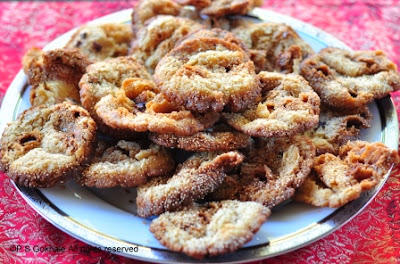
Anarsa (plural- Anarse), is a sweet snack made during Diwali. It is a delicacy and is known to be one of the trickiest things to make. Anarse must be fried in pure ghee/clarified butter and not shortening to get the authentic taste. Commercial sweet shops have turned to making these in shortening, but you can make out the stark difference in taste and quality between the two. These are sweet, deep fried and have a lace like texture making and absolutely delicious. Well made anarse will melt in your mouth.
Anarse is considered difficult to make, mainly because if there are any missteps in the dough making or frying process, the anarsa will completely disintegrate into the ghee while being fried. And, that can be very frustrating especially considering the amount of time and effort that going into preparation. However, the end result is so delicious that I would encourage you to give it a try.
Now, I made this using input from a lot of sources. My Mom gave me tips from her memories of my grandma making it. Then, my Mom-in-law gave me her process of making the dish and I also did a lot of searching online and in recipe books. The reason why I had to refer to so many sources was that while the basic recipe that was provided was similar, the tips that were provided by each source were invaluable.
Ingredients
1 cup rice (I used basmati)
water
1 cup jaggery, finely chopped/grated
2 tbsp white poppy seeds/khus khus
clarified butter, enough to fill your frying vessel to a depth of 2-3 inches
1 tsp cornflour
2 tsp ghee
1 tsp powdered sugar (not icing sugar)
Method
Dough preparation
Soak the rice for 3 days, changing the water every 24 hours. At the end of 3 days, discard the water and spread the rice to dry on a clean cotton cloth. This can be your kitchen counter top or dining table. It is not to be dried in the sun. I ended up drying the rice till there was no trace of moisture, however I was later told that you are supposed to dry the rice only till it is damp. Next, grind the rice to a fine powder and then sieve it with a fine sieve, so that any large particles are removed. This was another step that I missed, however the rice powder was fine enough to not cause any issues with the dough.
Once you have the fine rice powder, mix it thoroughly with the jaggery and 1 tsp of ghee, without adding any water. The moisture from the damp rice and the stickiness of the jaggery should be sufficient to bring the mixture together to a hard dough like consistency (it maybe a little powdery and not dough like, but that is okay). Keep this in an airtight box and set aside on the counter in a moisture free area, for a few days. Your mixture is ready to use after a week.
Now, when you are ready to fry the anarse, add the cornflour, 1 tsp ghee, and powdered sugar to the rice and jaggery mixture and knead it into a dough. If necessary, add 1-2 tsp milk to form it into a dough. The dough should be hard (puri consistency) and not soft and easily stretchable.
Frying process
Heat the ghee in a pan with a small diameter. There should be enough ghee to fry the anarsa, about 2-3 inches. Ghee will bubble when the anarsa is added to it. Hence, the pan must have high edges to prevent the ghee from spilling over. The smaller the diameter, the easier it will be to control the frying process. I used a 15 QT/1.4 L saucepan which has a diameter of about 6 inches and I could fry only one anarsa in there at a time.
Spread some poppy seeds onto your rolling surface. Then, take a small piece of dough and roll it into a ball, about 1 inch in diameter. Then, flatten and roll it out on the poppy seeds, into a flat disc. This way the poppy seeds will be embedded into one side of the disc. The disc should be about 2 inches in diameter and 3-4 mm in thickness, like a thick puri.
When the ghee is hot enough, set the temperature to medium heat and slip the flat disc carefully into the ghee, with the poppy side on top. As the anarsa is cooked, it starts to spread in the ghee. Using a spoon lightly hold the anarsa against one side of the pan, so that it doesn't spread a lot and start breaking.
As, the anarsa gets fried, a lot of bubbling will occur and lots of froth will be formed, making it a bit difficult to check if the anarsa is cooked. Keep pouring ghee on the top of the anarsa as it cooks, to cook the top side. Do no flip the anarsa over or the poppy seeds will burn.
As the bubbling subsides, you will be able to see the anarsa starting to brown. Remove it as soon as it is a light brown and let it rest on a paper towel. The excess ghee will get absorbed.
When the anarsa is taken out of the ghee, it is very soft. It will harden as it cools down.
Note: Since, I had very dry rice powder, my resultant mixture was also in a powder form. I kept it covered for 10 days hoping that some moisture from the jaggery would be released, but the weather was too dry and I had no luck with that. So, I finally was able to knead the dough only upon the addition of the ghee and other ingredients before I fried it and I also had to add a couple of tsps of milk to get it all together.
Tips
Use rice that is not sticky or glutinous for this recipe.
Do not dry the rice completely i.e. till it is completely free of moisture. The rice should be slightly damp when you grind it, so that when you mix it with the jaggery, a dough can be formed. Sieve the rice and discard any large rice pieces or grind the rice again till you get a fine powdered texture.
I checked on the rice, jaggery and ghee mixture every couple of days, to make sure that it wasn't getting spoiled.
Use enough ghee to fry the anarsa. Use a deep saucepan with a small diameter, just enough to fry one anarsa at a time and the depth of the pan should be sufficient so that the ghee doesn't spill over as it bubbles while the anarsa is being fried.
To check if the ghee is hot, add a pinch of anarsa dough into the ghee and if it starts bubbling and floats up, then the ghee is hot.
Do not flip the anarsa while frying, to prevent the poppy seeds from burning.